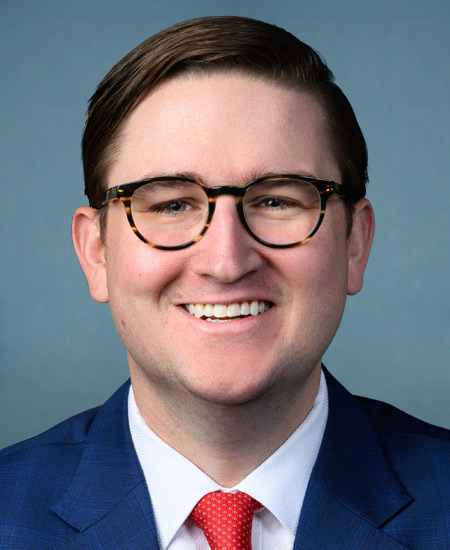
U.S. Representative, NC-06 · Republican · in Congress continuously since Jan. 3, 2025
GPO · public domain
The Executive Summary
Rep. Addison P. McDowell (R–NC-06) is not yet ranked. One block of the legislator rubric can be measured for McDowell — attendance — and a grade resting on that alone would not be comparable to grades built on the rest, so none is published. The rate itself is on this page. In NC-06, the district McDowell represents: unemployment runs 3.1% against 4.6% nationally; the median household makes $68,414 against $81,604; 12% live below the poverty line against 12.1%; 31.9% of adults 25 and over hold a bachelor's degree against 36.8%; and 7.7% carry no health insurance against 8.2% — Census one-year estimates for 2024, describing the place rather than anything McDowell did, and never part of any grade. Ranked by distance from the national figure — counting more unemployment, lower household income, more poverty, fewer degrees and more people uninsured as the harder side — the widest of the 2 gaps on the harder side are household income and bachelor's-degree attainment. Crime rates and school results are not published at congressional-district level by any official source, so North Carolina's statewide figures appear further down instead. How that compares with the district McDowell took over is a question this page leaves open: congressional lines are redrawn between Congresses, and the 2024 estimates — drawn for the 119th Congress — are the only published one-year vintage on the map this seat sits on today (2021 for the 116th Congress, 2022 and 2023 for the 118th Congress, and 2025 is not published). Differencing two districts that share a number but not a boundary would report a change in a place that did not change, so no district trend is shown here; what can be followed across the years instead is the record itself — votes cast, votes missed, and measures sponsored. In the 119th Congress, McDowell has missed 1.2% of recorded votes — 8 of the 676 roll calls the House printed their name on, below the 1.9% median for sitting representatives, and the 287th-highest rate of 431. McDowell is recorded on 4 tracked major laws: for 4. In the 119th Congress, McDowell has sponsored 19 bills and resolutions, spread across 9 of the Congressional Research Service's topic labels; the two largest groups are Crime and Law Enforcement (3 of 19) and Health (3 of 19). Set beside the district's widest gaps: of those 19, none is filed under Education; the catalogue has no label about household income, so that gap has no counterpart in this list. A filing label is where the Research Service shelves a measure so it can be found again — it says what a bill is about as filed, not what it did — and sponsoring is not passing. Read that pairing as a topic match and nothing more. Every figure is drawn from the cited public record; the full breakdown — including what can't yet be measured fairly — is below.
Graded on 0 of 4 components — 0% of the rubric. Every block of the rubric is hatched below: none of them can be measured for McDowell today, so no σ is published. The weight is held back, not handed to something else.
Block score:below chamber middleabovenot scored — no evidence, not a score of zero
Rubric component
Weight
Block score
Into the grade
Their district: how it moved on their watch reserved
no defensible district trend exists yet (redistricting)
33%
—
—
Bills they move (LES) reserved
no verified Legislative Effectiveness Score for this member
40%
—
—
Fiscal votes (CBO-scored laws) reserved
needs recorded votes on at least 3 laws carrying a CBO deficit estimate; 1 so far
13%
—
—
Attendance (missed votes) reserved
attendance is the only block that can be measured for this member so far, and a grade resting on it alone would not be comparable to the others — the rate is published on this page without being scored
13%
—
—
A hatched slot is not a bad score, and not a zero. It is weight the rubric set aside because the evidence to fill it does not exist yet, and nothing on this page says which way McDowell would have scored on it. That weight is never redistributed to the blocks we could measure, so no σ is published at all until at least one block can be measured. The weights are preregistered and identical for all representatives — this measures a record against a fixed rubric, not a person’s worth or effort. How the grade works →
Addison P. McDowell
U.S. Representative · NC-06 (North Carolina) · Republican · current term began Jan. 2025
Missed votes 119th Congress only, not lifetime career · “Not Voting” only; “Present” is a recorded position · House Clerk roll callsThe roll call records whether a member voted, never why they did not.
1.2%8 of 676 roll calls
Party-line votes share of their Yea/Nay votes cast with their own party’s majority — agreement with their party, not a left-right position · 119th Congress only, not lifetime career · House Clerk roll calls
97.1%646 of 665 recorded votes
Promises kept
In human review
North Carolina context — not this member’s grade
House members represent a district, not the whole state, so state numbers aren’t their grade. District-level scoring is in development. The state’s governor, Josh Stein, is not yet ranked; the state page carries the full outcome record.
Scored on their own record; district outcome scoring is in development. Methodology v3.0
The district, as context — where McDowell starts from
NC-06’s own numbers from the Census Bureau’s American Community Survey (2024 one-year estimates), each beside the national figure. These are levels, not trends — they describe the district a member answers to, not anything the member did — so they are context only and never enter McDowell’s grade.
Category
NC-06
United States
Unemployment rate
3.1%
4.6%
Median household income
$68,414
$81,604
People below the poverty line
12%
12.1%
Bachelor's degree or higher (adults 25+)
31.9%
36.8%
No health insurance
7.7%
8.2%
Source: U.S. Census Bureau, American Community Survey 2024 1-year estimates, by congressional district. ACS figures are survey estimates and carry margins of error. Crime rates and tax burden are not in this table because no official source publishes either at the congressional-district level — the statewide figures below are the closest honest substitute, and that gap is stated here rather than filled with an estimate.
North Carolina, as context
McDowell represents a district; where the Census publishes district-level figures they appear above, and this table is the wider picture — North Carolina’s statewide numbers: the latest verified level for each scored category, shared by the whole delegation, the governor and a legislature. Some of these (crime, tax burden) exist only statewide — no official source publishes them by district. Context only — none of this enters McDowell’s grade. The trends, scores and sources live on the North Carolina page.
Category
Latest statewide figure
Year
Air quality
41 AQI
2024
Cost of living
94.33 index, US=100
2024
Early literacy
41.7 % of 4th-graders below basic
2024
Education
275.8 scale score
2024
Energy cost
14.13 cents/kWh
2024
Food-aid access
0.88 index (higher = easier access)
2023
Gun deaths
16.3 age-adjusted deaths per 100,000
2024
Health coverage
12.75 % of adults 18-64 uninsured
2024
Homicide
7.8 age-adjusted deaths per 100,000
2024
Jobless-benefit access
12.73 % of unemployed receiving UI
2024
Obesity
34.48 % of adults
2024
School shootings
1 people killed or wounded
2024
Tax burden
5.4 % of personal income
2024
Teen births
14.3 per 1,000 females 15-19
2024
Unemployment
3.8 %
2025
Water quality
2.44 % of systems with a violation
2025
Wellbeing
4.6 mean poor-mental-health days of 30
2024
The national debt on their watch
context — not this member’s grade
When McDowell first entered Congress in 2025, in the House, the federal debt stood at $35.46 trillion (end of fiscal 2024; Treasury). As of 2026-09-17 it is $40.09 trillion (Treasury, daily). That rise spans presidents, majorities and economies — it belongs to no single member, which is why it is context here and part of no grade. What is McDowell’s own: their recorded votes when the major fiscal bills came through, beside what the Congressional Budget Office estimated each law would do to deficits.
Total public debt outstanding, fiscal 2024–present, in nominal dollars — no adjustment for inflation or the size of the economy, so early decades understate their era’s burden. Y-axis starts at zero. Source: Treasury. Shaded spans and dashed marks (dated on the rail below the chart): exogenous events — recessions as dated by the NBER, the COVID-19 emergency as dated by the WHO, and NOAA-recorded $100B+ hurricanes — the outlier years are theirs, not any one officeholder's.
Reading these: a baseline is CBO’s projection of what the government would spend and collect if the law never changed — the measuring stick a bill’s cost is measured against. Choose a different stick and the same law scores differently, which is why CBO publishes more than one and why each figure below carries the basis it was scored on. The differences are in the sticks, not in the arithmetic.
Debt figures as of the data refresh on 2026-09-21. These same votes feed the grade’s fiscal-conduct block (10%, methodology v2.5) — the debt itself feeds nothing: it belongs to no single member, and only their own votes are scored. The change is preregistered and dated in the changelog.
Integrity Record
facts from official records — not a score
No checkable commitment by McDowell has been tested by a recorded vote in the harvested window. This panel holds facts, not a score: what McDowell committed to on the record in words a computer can test, what their name was formally on, and what evenly-bipartisan bodies or courts have found — each line beside the record it rests on. Honesty is not numerically scored on this site; adjudicated findings, when final, cap the grade under a preregistered rule. Read the full rulebook.
1. Checkable commitments
spoken floor pledges a computer can test — window 2026-03-01 to 2026-08-31
No checkable commitment from McDowell compiled in this window. 1 pledge-shaped sentence by McDowell was harvested and excluded with published reason codes (hedged, no named bill, reported speech, and the like) — excluded means the computer could not test it, not that it was broken or kept. A commitment appears here only when it names its own test — a specific bill, in the sentence itself — and the test can be read from a recorded vote or the bill’s official record. Vague promises are listed in the site-wide exceptions feed, never rated.
Transparency context: McDowell spoke ~2,839 attributed words on the floor in this window, with 3.52 pledge-shaped sentences per 10,000 words. Strategic silence is visible here without being scored.
2. Name-vote consistency
formal endorsements vs. final-passage votes, same text only
No qualifying endorsement-vote pair for McDowell in the 119th Congress so far. Qualifying is rare by design: the pair counts only when the text at the vote is essentially the text they signed, and committee amendment breaks that on most bills that reach the floor — every excluded pair is in the public exceptions feed with its reason.
3. Adjudicated record
findings by courts and evenly-bipartisan bodies — the only tier that can cap a grade
Record search: 1 of 6 sources connected — House and Senate discipline votes (roll-call record). Not yet connected: Federal court judgments (deception statutes, ADJ-3 map); House Ethics Committee public reports; Senate Select Committee on Ethics public actions; FEC enforcement (MURs with admission or knowing-and-willful finding); GAO / Inspectors General findings naming members. Within the connected sources, McDowell has 0 qualifying events (as does every member — no adjudication event has scored site-wide). A final Tier 1 finding caps the overall grade at F, Tier 2 at C−, Tier 3 at B — caps only, never bonuses, under preregistered rule ADJ-7.
What this panel measures: matches between McDowell’s formal signed acts, spoken checkable commitments, and the official record — plus findings by courts and evenly-bipartisan bodies. What it does not measure: truthfulness of speech in general, campaign promises, effort that leaves no record, or motive. Items the rules cannot decide from records are excluded and listed, never guessed. Dispute anything: challenge@politicalgrades.com.
These are the major bills this site tracks line by line — not a full voting record. A member casts hundreds of votes a Congress; these 4 are the ones whose spending has been extracted and cited from the enacted text.
Every date links to the official roll call in the chamber where McDowell cast the vote. “Did not vote” is not “absent” — the record shows no vote was cast and gives no reason, which is often illness, travel or a paired vote. Nothing on this table is counted toward or against McDowell’s grade.
These pies aggregate the largest verified spending items — appropriations and mandatory outlays — in the bills McDowell cast a recorded vote on, sliced by category, every dollar quoted from the bill text. Three kinds of dollar are excluded, exactly as on the bill pages: authorizations (permission for a future bill to spend, not money), guarantee ceilings (the government backstopping private loans, no cash out) and pay-fors (the taxes or savings that offset a cost, which is money coming in rather than going out). This shows what the bills contained, by McDowell’s own votes — not a claim that McDowell wrote the spending or that it did or didn’t work. Every dollar in these pies is quoted from the bill text and cited, item by item, on the bill’s own page.
Veterans compensation, pension and burial benefits — ADVANCE appropriation, first available October 1, 2026 (FY2027) — Department of Veterans Affairs — Veterans Benefits Administration$246,630,525,000
recorded on 4 of 30 tracked laws · 19 measures filed
Two different kinds of record sit below and they are not interchangeable. The first is a recorded vote on a law that passed, whose dollars this site has read out of the enacted text and quoted line by line. The second is a measure McDowell filed — a document introduced, which most often goes no further than a committee referral. A vote is not authorship: nothing here says McDowell wrote the spending in any of these laws, and nothing here says the money did or did not work. And a filed bill carries no verified money breakdown at all — this site has read exactly 31 bills line by line, and a measure outside that 31 appears below as a title and a filing label, nothing more.
The tracked laws — McDowell’s recorded position, and where the money went
H.R. 5895Energy and Water, Legislative Branch, and Military Construction and Veterans Affairs Appropriations Act, 2019 (Public Law 115-244)not yet in Congress$266.2B
Continuous service began Jan. 3, 2025; the last chamber vote on this law was Sept. 13, 2018.
Recorded on 4 of 30. 26 of these roll calls were taken before McDowell was in Congress, so those rows are an absence of opportunity, not an absence of McDowell. The bars divide each law’s tracked spending — the dollar figures written into the enacted text as exact amounts — which is not the same as the law’s fiscal size; authorisations, ceilings and pay-fors are excluded, and every category is quoted, item by item, on the bill’s own page — each category name under a bar links straight to its cited items there. Colours follow each bill’s own pie, so a category is the same colour here and on the bill page. 31 bills have been read line by line here; 30 of them carry a recorded roll call. H.R. 4820 was reported by committee and never enacted, so no member holds a position on it. Each position’s link to the official roll call is in How McDowell voted above, and the merged category totals across all of McDowell’s votes are in What McDowell voted to fund.
What none of this can tell you is your state’s share. Not one of the 967 verified spending line items across the 31 bills read line by line here names a state, and none states an allocation formula: the enacted text appropriates to accounts and programmes, not to places. Any per-state figure on this page would therefore have to be modelled by us, and a modelled number under a state flag is not a sourced number. So it is not published, and the gap is printed instead.
What McDowell filed in the 119th Congress
McDowell filed 19 bills and resolutions in the 119th Congress, catalogued by the Congressional Research Service under 9 filing labels. A policy area is a library catalogue term describing what a measure is about as filed. It is not evidence that anything was addressed, improved or affected — and none of these measures carries a money breakdown on this site.
CRS policy area
Measures filed
Share of McDowell’s 19
Crime and Law Enforcement
3
16%
Health
3
16%
Immigration
3
16%
Transportation and Public Works
3
16%
Science, Technology, Communications
2
11%
Armed Forces and National Security
1
5%
Government Operations and Politics
1
5%
Public Lands and Natural Resources
1
5%
Sports and Recreation
1
5%
Not yet catalogued by CRS
1
5%
Denominator: McDowell’s own 19 sponsored measures, of which 18 carried a CRS label when the source was built and 1 did not — measures CRS had not yet catalogued, not measures about nothing. Sponsoring is not passing, and volume is not effort. Filing labels come from the Congressional Research Service via the govinfo BILLSTATUS bulk data, as of Sept. 20, 2026; the same totals are read independently from the Congress.gov API and the two pipelines agree on all 531 of 531 members compared. The newest of these measures, each linked to congress.gov with its latest action quoted, are listed in the promise ledger above rather than repeated here.
Became law under McDowell’s own number: 0 of 15 law-eligible measures (bills and joint resolutions; simple and concurrent resolutions cannot become law). Congress routinely enacts a measure’s text by folding it into another vehicle, and that enactment is credited to the vehicle’s sponsor, not to this one. A low count — or zero — is therefore not evidence of failure and is not printed as one here.
The 43-day shutdown — McDowell’s record
Funding lapsed at midnight October 1, 2025 and ended November 12, 2025 — 43 days, the longest federal shutdown on record. Congress’s appropriations power makes funding the government its own duty, shared by every member — so every member’s page carries the same record: their recorded votes on H.R. 5371, the funding bill, on both sides of the lapse.
whether to accept the Senate's version and send the bill to the President
Nov. 12, 2025
For
Passed; signed November 12, 2025
Positions from the chamber’s own roll-call record, staged only after the parsed tallies matched the officially published results exactly. The record states who voted how; it does not assign blame — that judgment is the reader’s.
Total U.S. federal outlays for each fiscal year of McDowell’s current term. That’s the whole federal budget — mostly Social Security, Medicare, defense, interest on the debt, and prior commitments already on the books before this term began — not money McDowell personally directed. A president proposes, Congress appropriates, and no single official controls the total.
Nominal dollars — not adjusted for inflation. Bar lengths compare dollars of different years, so a longer bar can be higher prices rather than more spending. Do not read these bars as a real trend.
FY25
$7.01T74% in term−$1.77T deficit
Source: OMB Historical Tables, Table 1.1 (Summary of Receipts, Outlays, and Surpluses or Deficits: 1789-present) · figures · compiled Sept. 21, 2026. Fiscal years run Oct–Sep, so they do not line up with the start of a term — marked above with the share that fell inside this term.
Closed fiscal years published for this term so far: FY2025 only. FY2026 closes Sept. 30, 2026 and OMB has not published it. A short chart here means the term is young and the series stops at the last closed year — not that spending stopped.
How McDowell is graded
McDowell is not yet graded. A representative serves a district, not a state, and no honest district-level outcome trend exists yet — so the rubric grades only what can be measured of a member’s own work, and none of it can be measured for McDowell today: the bills block needs a completed-Congress Legislative Effectiveness Score, and the fiscal block needs at least three recorded votes on CBO-scored laws. Once either exists, it will be measured and the card above will say how much of the grade is real. Voting alignment and attendance are defined in the rubric but reserved, not counted.The state’s numbers appear above as plain context — latest statewide levels, never folded into a grade — until district-level scoring ships.
Legislative Effectiveness Scores come from the Center for Effective Lawmaking, which benchmarks each chamber’s average to 1.0. The missed-vote and party-line figures are computed by this site from the roll calls the Clerk of the House publishes: every roll call the chamber printed this member’s name on, for this Congress only, with the numerator and denominator shown beside each rate. The roll call records whether a member voted, never why they did not. Independent trackers of the same record are worth reading beside ours — a figure nobody can check against anything is worth less than one that survives comparison: this member on GovTrack, which has tracked Congress independently since 2004 and computes its own figures on its own definitions, so its numbers will not always match these. The Honesty ledger — promises matched against this member’s votes — publishes only with an evidence trail and two agreeing human reviews.